The Request for Proposal (RFP) process. For many organizations, it’s a critical path to winning new business, but it’s often a resource-intensive bottleneck. Teams spend countless hours sifting through dense documents, hunting down relevant information, and crafting responses – often reinventing the wheel with each new RFP.
What if you could automate the heavy lifting? What if you could leverage your organization’s collective knowledge and cutting-edge AI to generate high-quality first drafts in a fraction of the time?
That’s exactly what the RFP Response AI Machine is designed to do. Based on a robust architecture (like the one visualized below) and a modern tech stack, this system isn’t just about speed; it’s about smarter, more consistent, and ultimately more successful proposal generation.
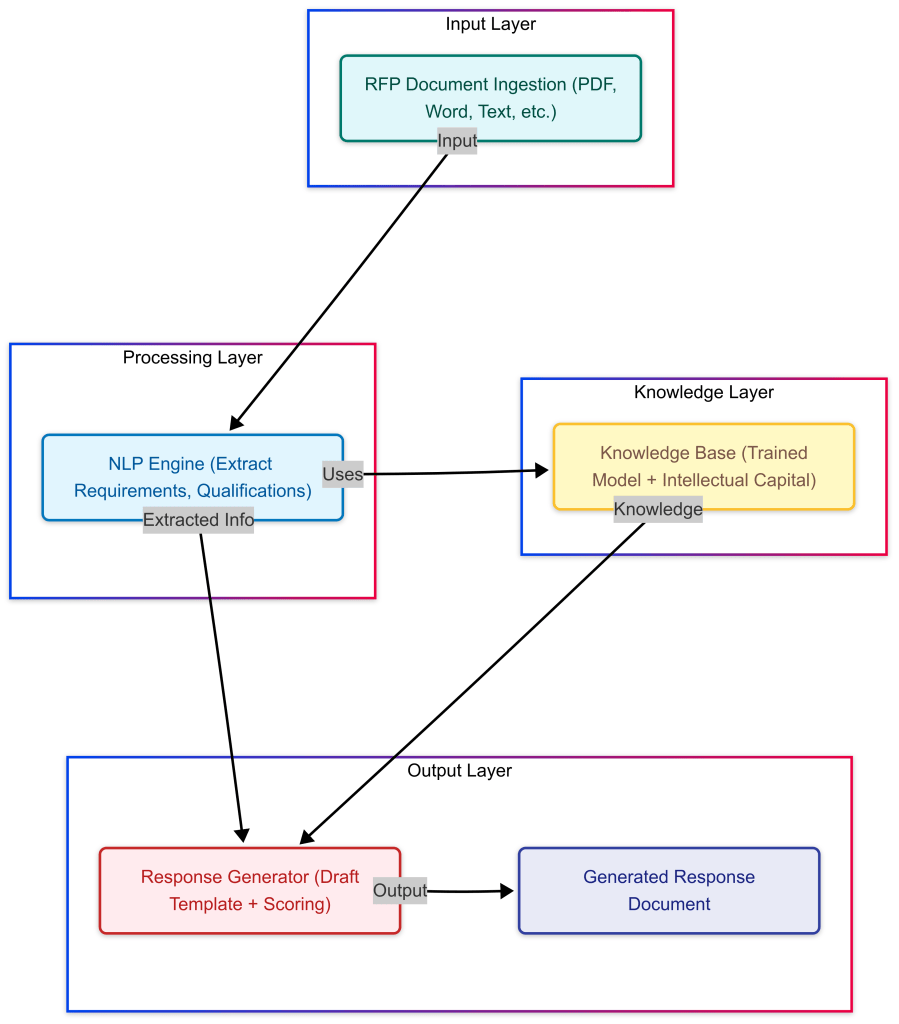
Let’s dive into the advantages of building such a system and the key steps involved.
The Unfair Advantage: Why Build an RFP Response AI Machine?
Implementing an AI-driven solution for RFP responses offers significant benefits:
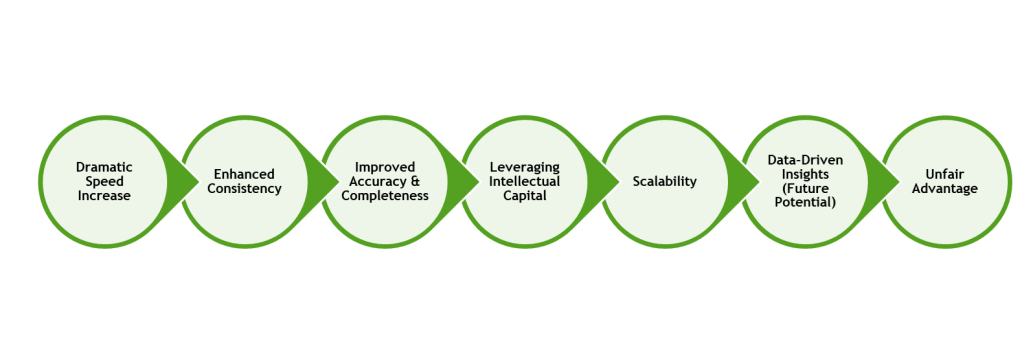
- Dramatic Speed Increase: Reduce the time spent on initial draft creation from days or weeks to potentially hours or minutes. This frees up your valuable subject matter experts (SMEs) and proposal teams to focus on strategic refinement, customization, and relationship building.
- Enhanced Consistency: Ensure all responses adhere to your company’s branding, tone of voice, and approved technical language. The AI leverages pre-approved content and templates, eliminating inconsistencies often found in manually compiled drafts.
- Improved Accuracy & Completeness: The AI meticulously scans RFPs to extract all requirements and qualifications. It then systematically searches your knowledge base, reducing the risk of overlooking critical questions or submitting outdated information.
- Leveraging Intellectual Capital: Your organization’s past proposals, technical documentation, case studies, and datasheets are valuable assets. This machine unlocks that knowledge, making your best, most relevant content easily accessible and reusable for new RFPs.
- Scalability: Handle fluctuations in RFP volume without needing a proportional increase in staffing. The machine can process multiple documents concurrently, allowing your team to pursue more opportunities.
- Data-Driven Insights (Future Potential): Over time, the system can provide insights into common RFP requirements, the effectiveness of certain responses, and areas where your knowledge base might need strengthening.
Prerequisites: Building the Foundation with a Knowledge Base & Training Model
Before diving into creating an AI-powered RFP Response Machine, it is essential to establish a robust Knowledge Base and Training Model. This foundational layer is where the intellectual capital of your entire organization is stored, indexed, and made readily accessible for automated response generation. The Knowledge Base should aggregate your company’s most valuable assets, such as past RFPs, technical documentation, case studies, and pre-written templates, all in a structured, easily retrievable format.
The Knowledge Base is not just a repository; it is the backbone of your AI system. It ensures that the AI can draw on accurate, up-to-date information, and respond with confidence to RFP requirements. Additionally, this data must be stored within a highly secure infrastructure, safeguarding sensitive information like product details and client data.
Accompanying the Knowledge Base is the Training Model. This model, often built from scratch or fine-tuned from an existing AI model like GPT, should be trained on your organization’s specific data, response patterns, and terminology. It learns the nuances of your business context and ensures the AI generates responses that align with your brand and voice.
Establishing this Knowledge Base and Training Model takes time, but it is a crucial step for the system’s success. In future posts, I will walk you through the step-by-step creation of a secure, well-structured Knowledge Base and how to fine-tune your internal AI model. Stay tuned for detailed guides on these key steps, and follow me for more insights into optimizing your RFP response process!
Under the Hood: Architecture & Technology Stack
Our proposed RFP Response AI Machine architecture breaks the process down into logical layers, powered by a specific, modern tech stack:
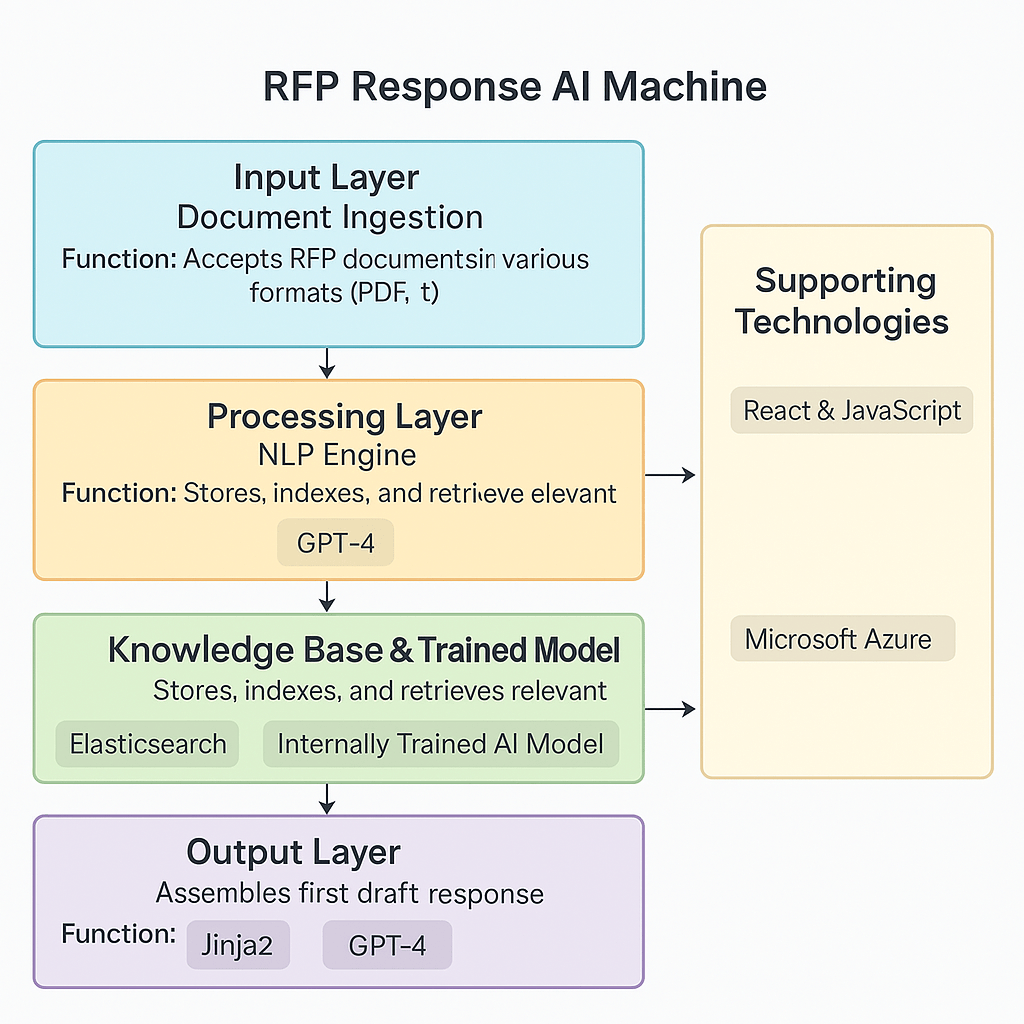
- Input Layer (Document Ingestion):
- Function: Accepts RFP documents in various formats (PDF, Word, Text).
- Technology: Google Docs API (or similar document processing libraries) parses and standardizes the input document text for downstream processing.
- Processing Layer (NLP Engine):
- Function: Understands the RFP’s content, extracts specific requirements, identifies question types, and pinpoints necessary qualifications.
- Technology: GPT-4 (or another state-of-the-art Large Language Model) provides the sophisticated Natural Language Processing capabilities needed to comprehend complex RFP language and structure.
- Knowledge Layer (Knowledge Base & Trained Model):
- Function: Stores, indexes, and retrieves relevant information from your internal intellectual capital. This includes pre-written answers, product details, company information, and templates. It’s augmented by an internally trained model that understands your specific business context and data.
- Technology:
- Elasticsearch: Acts as a high-speed search engine, indexing your knowledge assets for rapid retrieval based on queries generated by the NLP layer.
- Internally Trained AI Model: This model (potentially a fine-tuned version of a base model like GPT or a custom-built one) understands your unique offerings and response style. It works with the NLP engine to formulate better queries for Elasticsearch and helps synthesize information.
- Output Layer (Response Generation):
- Function: Assembles the first draft response by matching extracted requirements with retrieved knowledge, filling in a designated response template. It may also provide confidence scoring for certain answers.
- Technology:
- Jinja2: A powerful templating engine used to structure the final output document based on pre-defined response templates.
- GPT-4: Assists in generating human-like text to bridge gaps, summarize retrieved information, and populate the Jinja2 templates coherently.
- Supporting Technologies:
- Frontend: React & JavaScript create the user interface for uploading RFPs, managing the knowledge base, reviewing/editing drafts, and initiating the process.
- Cloud Platform: Microsoft Azure provides the scalable and secure cloud infrastructure to host all the components, databases, and APIs.
Building the Machine: Key Steps
Creating this system is a significant undertaking, but breaking it down makes it manageable:
- Phase 1: Discovery and Planning:
- Clearly define the scope: What types of RFPs will it handle? What level of draft quality is expected?
- Identify success metrics: Time saved, SME effort reduction, draft completion rate.
- Map out data sources for the knowledge base.
- Finalize detailed architecture and technology choices within the Azure environment.
- Phase 2: Data Curation and Knowledge Base Setup:
- Gather, clean, and organize your intellectual capital (past RFPs, boilerplate text, product docs, marketing materials).
- Design the Elasticsearch index schema for optimal retrieval.
- Ingest and index the curated data into Elasticsearch.
- Crucially: Train or fine-tune your internal AI model on your specific data and response patterns.
- Phase 3: Core Component Development (on Azure):
- Ingestion: Build microservices/functions using the Google Docs API (or alternatives) to handle document intake and parsing.
- NLP: Integrate GPT-4 via its API to process parsed text, extract requirements, and generate semantic queries.
- Retrieval: Develop the logic connecting the NLP output to Elasticsearch queries and retrieving relevant knowledge snippets.
- Generation: Create services that use Jinja2 templates, orchestrate calls to GPT-4 for text generation, and assemble the draft using retrieved knowledge.
- Phase 4: Frontend Development:
- Build the React application, focusing on a user-friendly interface for managing the end-to-end process.
- Phase 5: Integration, Deployment, and Security:
- Connect all microservices/functions via APIs within Azure.
- Implement robust security measures, especially given the sensitive nature of RFP and internal data.
- Deploy the full application stack onto Azure infrastructure (e.g., App Service, Kubernetes Service, Azure Functions).
- Phase 6: Testing and Iteration:
- Test rigorously with a diverse set of real-world RFPs.
- Gather feedback from proposal teams and SMEs.
- Iteratively refine the NLP extraction, retrieval logic, response generation, and the internal model based on performance and feedback.
In conclusion, building an AI-powered RFP Response Machine offers an unparalleled opportunity to revolutionize the way organizations approach the complex and time-consuming task of drafting proposals. By leveraging the power of artificial intelligence, businesses can dramatically speed up the proposal process, enhance the quality and consistency of their responses, and ultimately drive better outcomes in their pursuit of new opportunities. The combination of sophisticated Natural Language Processing (NLP) models, like GPT-4, with a well-structured Knowledge Base and a secure infrastructure ensures that your system is equipped to handle even the most complex RFPs with accuracy and ease.
The AI-driven solution not only streamlines the drafting process, but it also ensures that responses are tailored to each specific RFP, drawing from a rich library of pre-written content, case studies, product information, and templates. By leveraging past intellectual capital, the system can access a vast wealth of knowledge, ensuring that responses are as relevant and customized as possible. This method also allows your teams to focus on high-value activities, such as refining strategies, building relationships with clients, and ensuring that each response reflects the company’s best interests.
Moreover, as your RFP Response Machine learns and evolves over time, it becomes even more effective. The system can start identifying patterns, uncovering insights about recurring requirements, and suggesting ways to optimize responses. With a continuously improving process, organizations are better equipped to scale their operations without needing a proportional increase in resources, offering tremendous potential for growth.
However, it’s important to note that success in implementing such a system begins with a strong foundation. Without a well-organized Knowledge Base and a properly trained model, even the best AI tools will struggle to provide accurate, effective responses. As mentioned, a secure and internally hosted Knowledge Base that consolidates your company’s valuable IP is crucial for the system’s success. It ensures that the AI has access to high-quality, up-to-date information while keeping sensitive data secure.
In upcoming posts, I will guide you through the process of setting up your Knowledge Base and Training Model, step by step, so that you can begin to experience the transformative power of AI in your own RFP response workflow. If you’re ready to take the next step in optimizing your business’s proposal process, follow me for more insights, tips, and practical guides. The future of proposal writing is here, and with AI, the possibilities are endless.


Leave a Reply